There is no fighting the pregnant waddle, but there's still more to learn. Researchers are studying how the altered gait affects women's lives.
Tuesday, July 5, 2016

CML Life Expectancy on Rise: Oncotherapy Network & Cancer Network
(MedPage Today) -- Also, risk factors across ovarian cancer subtypes vary
Are Three Quarters of CMOs Wrong About Customer Experience?
Customer experience (CX), to absolutely no one's surprise, is at or near the top of the list of priorities among CMOs across the globe. There is no denying the importance of delivering the optimal CX to every customer, every time.
However, inherent in CX itself is a list of priorities as to what makes for a great CX; what qualities if you will, compromise the best CX. Well, according to a recent article on Marketing Charts, when asked to name their top 5 attributes and elements of the customer experience over 170 senior marketing leaders chose these:

The top five identified in order were: (in descending order)
5. A person to speak with regardless of time or location.
4. Clear, consistent messaging and information across channels.
3. Knowledgeable staff ready to assist whenever and wherever the customer needs.
2. Consistency of experience across channel.
1. Fast response time to issues, needs or complaints.
So Why Is This Wrong?
Before I get to that, it's important to put the word "wrong" in the right context, as it were.
The word has many meanings, many of which such as "not in accordance with what is morally right or good" have nothing to do with the context here. However, one of the meanings of the word does: "not correct in action, judgment, opinion."
The reason I say this is not because I think providing fast response times is not important. Far from it. It is incredibly important. The reason I use the word "wrong" is these surveyed leaders are not placing enough importance on cross-channel and the need - the vital need to provide a seamless, cross-channel customer experience.
It's no secret that the best customers are the ones who engage with brands across multiple channels. It's not surprising, therefore, that the brands who deliver value to customers across channels see strong growth.
How much growth?
- Companies with strong cross channel customer engagement see a https://www.internetretailer.com/2013/12/31/why-omnichannel-strategy-mattershttps://www.internetretailer.com/2013/12/31/why-omnichannel-strategy-matters in annual revenue.
- Cross channel customers who shop on more than one channel have a 30% higher lifetime value score than those who shop on only one.
- Then add in the fact that, according to Forrester, cross channel retail sales in the US alone will be nearly $2 trillion by 2018-and you can see why delivering a strong cross channel experience is paramount for success.
Today's consumers are demanding: they have become more unforgiving of a poor customer experience and expect interactions on their desktop and mobile devices to be responsive, intuitive, and easy to use. Marketers understand that delivering the most relevant experience is the key to gaining continued satisfaction and loyalty from their digital consumers.
Oftentimes, however, when it comes to marketing to consumers there are two dynamics. On one hand you have what consumers say they want out of a customer experience. On the other hand, there is what they actually receive.
What they want are experiences that are personalized, contextually relevant, and consistent-regardless of online or offline channel or lifecycle stage. What they too often get, however, are experiences that are disconnected, not contextually relevant, and inconsistent across channels and lifecycle stages.
So by all means continue to place a high value on the need to provide fast response times and human interaction as a whole.
But there is no denying the fact that ours is a cross-channel world and to deliver the maximum customer experience across all these channels you need the right technology.
Download The CMO Solution Guide to Leveraging New Technology and Marketing Platforms and hear directly from your fellow CMOs as to what they look for in a martech solution.


Modern-Day Da Vinci: How Great Content Merges Science and Creativity
Has your inspiration for engaging content ideas hit a brick wall? Do you feel like despite all your efforts, your content is falling on deaf ears?
First off, take comfort in the knowledge that you're not alone. According to the most recent Content Marketing Institute reports, producing engaging content is the biggest challenge for a whopping 60% of B2B and 56% of B2C content marketers.
Why is it so hard to make stuff that people want to engage with?

Hint: Great content marketing requires you to be a modern-day Renaissance (wo)man like Leonardo Da Vinci. Image source.
We need to be data scientists.
Long gone are the days when marketers could woo the masses with company-centric material. Now, in the era of consumer control, content must address the problems, questions and desires of real people to convince consumers to go on a first date and then possibly take the relationship further.
To better understand said problems, questions and desires, we need to collect and analyze data on the people we're trying to talk to.
But we also need to be creative.
Consumers have access to more information than ever before, so content needs to stand out against a shedload of good, bad and ugly content. It needs to be different in some way to be engagement-worthy.
In a nutshell, content must now be relevant and innovative, and this is a tall order of the skyscraper variety.
How can we make stuff that people want to engage with?
To rise to the challenge, content marketers need to strike a balance between the science of content marketing – data analysis and experimentation – and creativity. To create a content masterpiece, one must basically aspire to be a 21st century Leonardo Da Vinci.

NBD. Image source.
No pressure then.
I'm going to suggest a three-step methodology that integrates science and creativity to help you craft content that amazes and engages.
I hope to help you analyze data to find engaging content ideas, use creative thinking to turn data-fuelled ideas into inspired creations and experiment with your creations to create pieces that your audience truly love.
Let's hop to it.
Step 1: Use customer insights to inspire content ideas
Staring at a blank page? Use the powers of observation to feed your inspiration.
The first step is to observe visitor behavior. You can start by analyzing the actions of your blog visitors. This will not only give you valuable insights into what they want to read about, but also some much-needed fuel to spark ideas from.
Once you have a better understanding of what topics get them to interact with you, you can then develop content ideas around similar themes.
It's time to don your data scientist hat, log into Google Analytics and answer the following questions:
Which are your most engaging existing blog posts?
Measuring the amount of time people spend on your blog posts is a nifty way to get insight into which topics resonate the most with your audience.
- Click on Behavior > Site Content > All Pages.
- Look at the Average Time on Page

- Note which posts have the highest Average Time on Page. These are your most engaging posts. In the example this is “/blog title 2” and “/blog title 3”.
- Look at any similarities between these posts, e.g. topic, format, style.
- Use your findings to brainstorm ideas for your next content piece.
Which search terms bring in the most organic traffic?
You can also find out which topics prospects want to learn more about by looking at your organic traffic.
- In Google Analytics, go to Acquisition > All Traffic > Channels
- In the table, click on Organic Search.
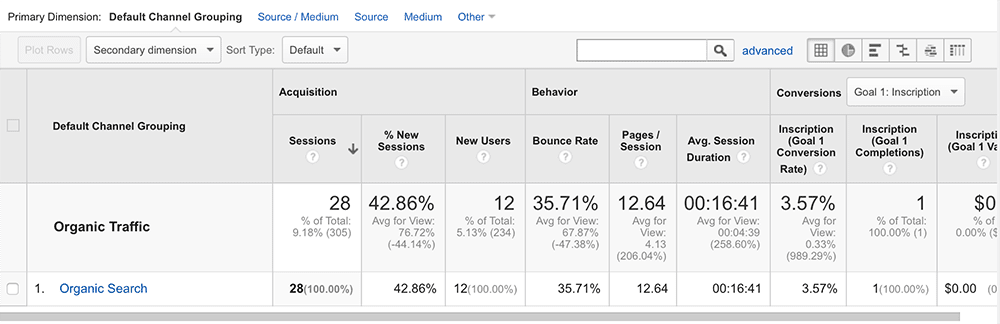
- In the first column you have a list of the most popular keywords used to access your website.

Image via Kissmetrics.
- Note down the most popular terms (not including your company name) and brainstorm your ideas around them.
Ted Karczewski, Content Marketing Manager at Skyward, told me that one way his company finds inspiration for engaging content ideas is by analyzing popular SEO terms in Google Analytics.
In 2014, Skyward saw a large volume of people arriving at their blog via the search term “Instagram marketing.” This was a pretty good indication that people were interested in reading about this topic.
Off the back of this observation, Skyward created a series on Instagram marketing that “generates thousands of views each month, ranks highly for the phrase and converts new readers to subscribers.”
Insights into the behavior of your visitors are starting blocks for creating engaging content. Use the information at your fingertips to spark ideas for your next hyper-relevant content piece.
Step 2: Use creative thinking to transform data into innovative content
“In this new fast-moving ever-changing environment, creativity is not a luxury or a risk. It really is a necessity.” – David Usher, Let the Elephants Run
Data and analytics are essential to understanding consumer behavior and driving interactions that create business value. But…
(Yes, there is a “but”)
…these things alone are often not enough to create actions that create an amazing customer experience.
Bill Gates predicted that the web would become the “multimedia equivalent of the photocopier.” Lo-and-behold, we're seeing a lot of the same ol' and it's getting evermore difficult to create something that feels truly original.
To make content stand out, we need to integrate creativity into the content creation process. Creativity allows you to tell a story that may have been told many times before in a way that goes against the grain.
Simon Berg, CEO of content marketing platform Ceros, predicts that this year content marketers will need to be creative “to drive engagement and results in the future.”
Want more expert advice to help you crush your marketing goals?
Sign up to get the latest digital marketing tips delivered straight to your inbox.
From analytical to creative thinking
Contrary to popular belief, creativity isn't a gift that only a portion of the population is born with.
It is in fact a learned skill, as this CoSchedule article explains. Anyone can learn to change his or her perspective on reality and integrate creativity into the content creation process.
Once you've done some digging into your customer data and decided on the subject you want to run with, it's time to ask yourself: “what's the most creative way I can deliver my message?”
Here are a few questions you could ask yourself to sprinkle some creativity over your content creation process:
How can I make my content visually awesome?
Everyone's favorite content marketing mentor HubSpot tells us that visual content is easier to mentally process and understand. And you only need to look at the success of visual content platforms such as Instagram, Pinterest and YouTube to know that content that appeals to the optical senses is in vogue. Infographics, videos and drawings are just some of the formats you could use to communicate your message visually.
Here's a handy list of free tools, compiled by HubSpot, to get you started creating visual web content.
How can I make my content stand out?
It's no good reproducing the same old content you can find on your competitors' websites. To create refreshingly different content that reflects your individuality, turn your attention away from your competitors and look to your own business. Ask yourself:
- What are the core values of my business?
- How would I describe my company's personality?
- How can I reflect these things in my content?
Video marketing platform company Wistia engages customers with content that reflects the companies individuality.
According to Wistia's CEO Chris Savage, during the first five years the company produced “boring” and “anonymous” content that failed to attract customers. But once it began to produce content that reflected the company's quirky personality, it saw engagement levels shoot up.
Step 3: Experiment! Measure and improve your content
In content marketing - as in science and in life - no matter how much work you put into research and creation, the results are never 100% guaranteed.
Now that we've used science to analyze our data and creativity to improve our ideas, we will again use science to measure and improve the success of our content.
The best way to optimize your content's chances of success is to test it out on your audience, look at the results and repeat what works well. But where exactly does one begin?
If you're at a loss, headlines are a great place to start. They're the first element of your content that audience sees, so it's damn important to get them right.
A/B test headlines in WordPress
Optimizely's WordPress plugin allows you to test headlines directly in WordPress.
Once you've installed and configured the plugin on WordPress, you can publish a post on your website with as many headlines as you like.
- In WordPress, click on Posts and Add new.

- Get your wordsmith on. Type in your article and click Publish as usual.
- In the A/B testing column on the right-hand side of the screen, enter in as many headlines as you like (you defined the number when you configured the plug-in). Optimizely tells us that “the more headlines you test, the longer it will take to get to statistical significance,f” so I'd recommend using 2 or 3 headlines max to start with. Then click Create Experiment.

- Once you click Start Experiment, your headline experiment is live. You can track your results at any time by clicking on View Results in the same page.

- Analyze your results. Is there one headline that outperforms the others? Use this headline for your blog post! And then ask yourself why it did well so you can replicate your success.
A/B test headlines on social media
Testing headlines on social media is a less scientific method than testing headlines directly on your website, but it can still give you some insight into which headlines are the most effective.
Social media mogul Buffer A/B tests all their headlines to find which ones resonate most with their audience.
For example, Buffer published the same blog post on Twitter under two different headlines:

Based on a higher engagement rate with the second tweet, Buffer chose to use the second headline for the blog post.
To this date this article has been shared nearly 5,000 times on Facebook, a success that Buffer's CEO Leo Wildrich largely attributes to choosing a headline based on audience feedback.
Testing your headlines is just one way you can perfect your content and create something your audience will really want to engage with - you're limited only by your creativity!
Creativity needs science like science needs creativity
These days it takes more than data to wow people. It also takes more than just an innovative idea to succeed. Content marketers need to balance science and creativity to create content that stands a chance of getting noticed.
The actionable methodology above, which unifies science (data analysis, experimentation) and creativity, is one way to integrate both branches of knowledge into your content marketing process to help you continuously create content that is customer-focused and innovative.

9 Social Media Marketing Trends That Could Make or Break Your Business in 2017

Social media is always evolving, so what's next?
That's the question I was asked in an interview recently. This kind of question can be really easy since there are so many easy candidates – IoT, VR, and just about anything to do with Facebook.
But if you don't want to rely on the cliches of future social technology, it can be a challenge to pick out what will matter and why. I suppose this post is somewhere in the middle and I hope it helps you think about where the substance breaks away from the shiny social media objects.
The most important thing about social media marketing isn't always the tech. It's the people.
A lot of what draws marketers' attention to social media is technology: new apps, networks and the latest features on major platforms. But the most important thing about social media marketing isn't always the technology. It's the people and how they use that technology to create, publish, share, interact and transact.
Social media is a dynamic of consumer behaviors driving new social technology development while at the same time, new technologies that affect consumer behaviors. It's important for brands looking at what's next in social media to understand this dynamic amongst their own customers and broader community.
With that dynamic cycle of people and technology in mind, here are a few directions for social media evolution I think are worth paying attention to:

1. The Facebook Internet
Facebook is dominating social media usage, video and advertising and I don't see that changing anytime soon. Along with WhatsApp messaging and predictions that Instagram will soon become the second biggest social network, many Facebook users don't really need to leave, do they?

2. Converged Social
The combination of Microsoft and LinkedIn will create innovations that will benefit marketers in some interesting ways, especially if professional social profiles become accessible and integrated within Microsoft 365 apps. There's more convergence to come and guesses are hot as to whether Facebook, Google or Apple will buy Twitter or if Twitter will go the way of Friendster and MySpace.

3. Hot Video
Real-time video is the hot shot on the block right now with Snapchat, Facebook Live and Periscope leading the way towards social engagement with customers in ways many brands haven't explored before. Facebook's own Nicola Mendelsohn says in five years, Facebook will “probably” be “all video”.
Like live TV, live video presents brands some opportunities for things to go differently than planned, like Mark Zuckerberg's inevitably comedic Q/A with Jerry Seinfeld on Facebook live that has reached over 9 million views. On the other hand, who wouldn't trade some awkward for the reach and exposure (159m views) of a Chewbacca Mom event?

4. Paying to Play Social
Social Advertising will continue to rise with even more options for advertisers. Social media advertising is projected to generate $11 billion in revenue by 2017, up from just $6.1 billion in 2013. More social networks and apps will expand their advertising offerings, just look at Snapchat now inserting ads in between users' “Stories” and Snapchat Partners, API access that will provide access to creating custom buying and management tools.

5. Dark Social
With 84% of global social shares dark to social media analytics, there's a growing importance, but brands are challenged to measure its effectiveness in ways that synch with other social media measurement. There's no shortage of recommendations on how to measure dark social, but we all need more concrete direction on this and collaboration between apps, networks and platforms to make it meaningful.

6. Social Chat Bots
Again, Facebook has opened doors for a new kind of engagement and with customers' expectation of real-time engagement, bots may be able to satisfy basic customer service and information needs for brands. Will bots be a service or communications solution for your brand? Maybe. At a minimum, brands will need to invest in more interactive social experiences for their community and what better what to that than an neural network and some AI?

7. Mobile First
Mobile traffic now exceeds desktop traffic and 2 billion consumers worldwide are expected to own a smartphone in 2016. There's nothing new about the importance of mobile friendliness or having apps, but the cost of ignoring mobile social media experiences for brands dragging their feet will rise dramatically.

8. Social Media Automation
“Martech Shock” extends to social media as brands look to automate and scale. The use of social media automation tools and platform features will grow to help brands with prospecting, delivering content to the right customers at the right time and engagement – all integrated with a marketing dashboard for end to end reporting of the impact social media has across the customer journey.

9. Social Content Participation
People are empowered and motivated more than ever to co-create social content with brands. If a brand makes that possible, I think consumers will be incredibly interested in co-creating content that serves mutual interests.
In a way, this kind of consumer and brand collaboration is tapping into the whole user-generated content phenomenon. There are so many ways to do it, especially because of mobile devices allowing people to participate at all times with brands on topics they're passionate about. Content can easily become an outcome of this type of participation, whether it's a video, image or even text.
Activating passionate people within a social network environment where they can co-create and participate is an exciting opportunity to scale reach, especially on platforms like Facebook that continue to penalize brand and publisher organic visibility in favor of content from individuals (and ads).
Here's the thing: Sometimes social media marketing often seems doomed to become nothing more than another advertising channel, with artificial automation schemes for brands to scale the illusion of customer engagement.
While that seems a bit cynical, I also think the collective power of individuals on social networks has never been greater – for content, engagement and influence. When brands and marketers can marry the wisdom and action of the crowd with technology that actually solves a real problem, I think the future of social media is brighter than ever.
A version of this post was originally published on LinkedIn.
Gain a competitive advantage by subscribing to the
TopRank® Online Marketing Newsletter.

© Online Marketing Blog - TopRank®, 2016. |
9 Social Media Marketing Trends That Could Make or Break Your Business in 2017 | http://www.toprankblog.com
The post 9 Social Media Marketing Trends That Could Make or Break Your Business in 2017 appeared first on Online Marketing Blog - TopRank®.


Amazon finally enables product orders through Echo
Amazon Prime members can now shop with their voice to purchase almost any Prime-eligible product using Echo.
Please visit Marketing Land for the full article.


Please visit Marketing Land for the full article.
Subscribe to:
Posts (Atom)